Posts

Crossdomain.xml can be overly permissive even without a wildcard (*)
Image
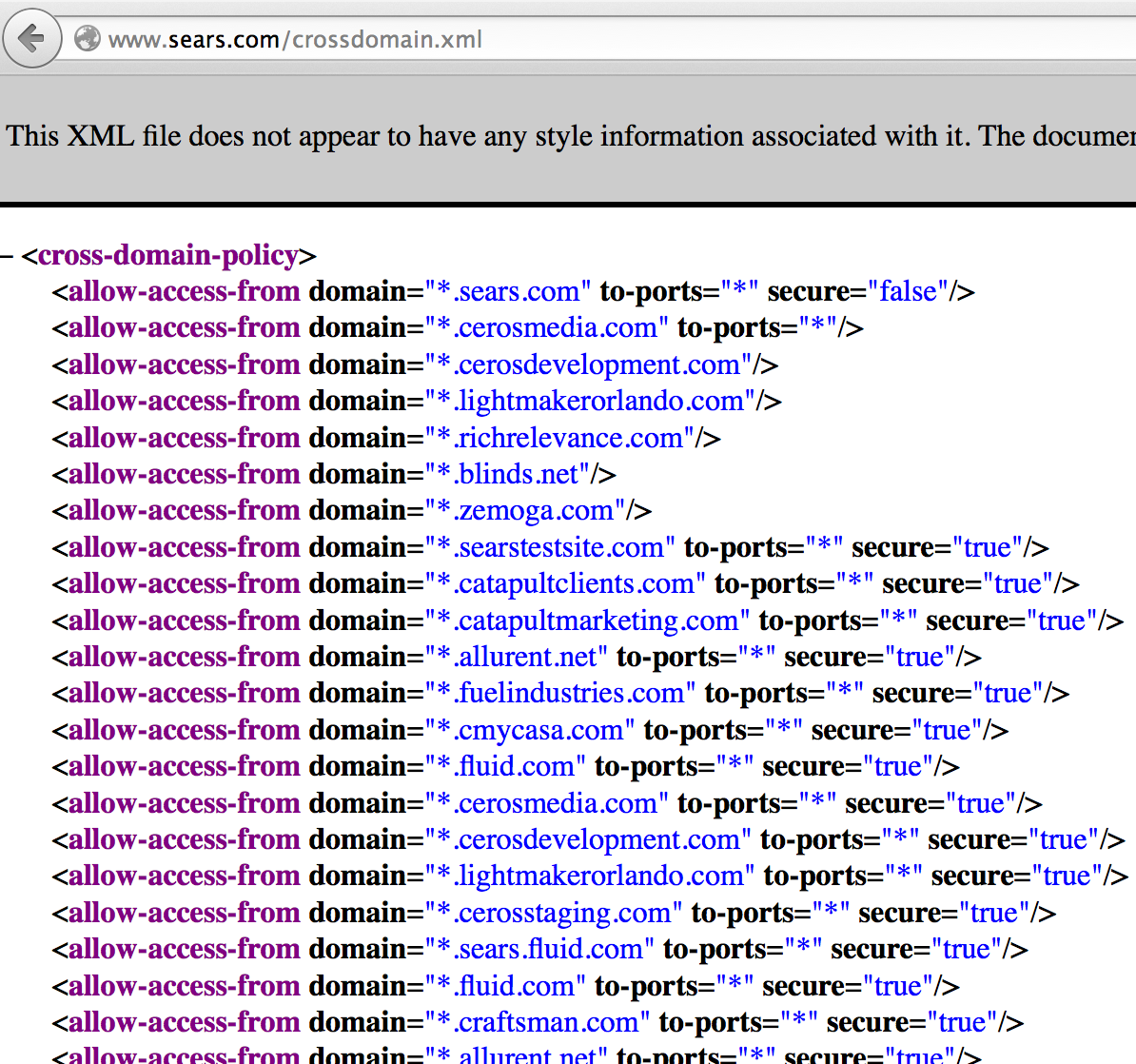
Before too much time passes, I want to write about a point I covered in my presentation that is not widely covered on the web -- or maybe not even covered at all. The main point is that even if you have a very specific list of domains that you trust, you may still be vulnerable to CWE-942 , if one of the domains that you trust is available for purchase. To illustrate this point in my talk, I used the crossdomain.xml file at www.sears.com: What I found in my research is that there are plenty of crossdomain.xml files that trust sites that are available for purchase.   As far as I know, every single security assessment tool out there would pass right over these sites, missing the fact that a vulnerable configuration could be in place. In the case of www.sears.com, they are trusting the domain: searstestsite.com. For the purpose of demonstrating the vulnerability, I purchased this domain. This means that I can now host a malicious SWF at www.searstestsite.com, a domain that...

BSidesDC 2014

Image
Presenting at BSidesDC was an amazing experience. I feel so lucky that we have our very own local con, and I am extremely grateful to the organizing committee and other volunteers who make this event happen. This is very similar to my DerbyCon talk, however it is 20 minutes longer which gave me time to walk through how to go from finding this vulnerability to exploiting it, including showing the audience how to create a POC SWF.  Also, I released SWF-Server, which will give you everything you need to create your own SWF to exploit this vulnerability. Download the project here: https://github.com/sethsec/crossdomain-exploitation-framework

DerbyCon 4.0 - SWF Seeking Lazy Admin for Cross Domain Action

Image
Abstract: Security misconfiguration is #5 on the OWASP 2013 Top 10. This talk shows how the misconfiguration of one file can compromise the security of an entire web application. In the talk, youll be introduced to the crossdomain.xml file.  This file determines how third party Flash Objects (SWFs) hosted on other domains can interact with your domain. Unfortunately, this file requires manual configuration on the part of the administrator, and as we all know, when manual configuration is required, mistakes happen.Sometimes, administrators give up and whitelist the entire internet in order to "make it work". This is essentially like adding an "accept all" rule on your firewall or setting your password to <blank>.  We will review how to identify the vulnerability, how to abuse it, and how to write your own SWFs that exploit the flaw. Examples of public sites that until recently contained this vulnerability will be provided, including a few from the Alexa ...

CVE-2014-2227

Image
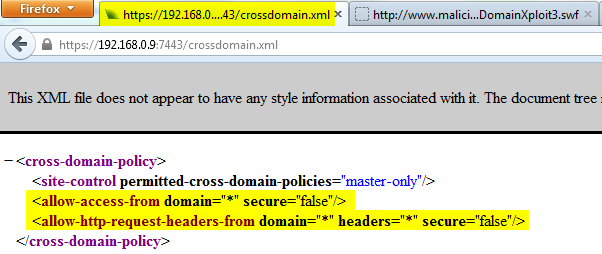
This CVE covers a vulnerability found in the Ubiquiti Networks AirVision application.  For more background on this particular vulnerability, check out this post: Exploiting misconfigured crossdomain.xml files In fact, I wrote that first crossdomain.xml blog post after finding this AirVision vulnerability back in February.  If you already read that post, you should recognize the vulnerable form I use for the POC here (adding an administrator), is the same one I used earlier. Here is a cleaned up version of what I sent to Ubiquiti back in February: AirVision Controller v2.1.3 - Overly Permissive default crossdomain.xml CWE-264: http://cwe.mitre.org/data/definitions/264.html Misuse Case If the victim user is authenticated with their AirVision Controller, and they visit a malicious site, the owner of the malicious site can make changes to, and read data from, the AirVision Controller. The malicious site can even add a new administrative user accou...

CVE-2014-2226

Image
Ubiquiti - UniFi Controller - Admin/root password hash sent via syslog CWE-310: http://cwe.mitre.org/data/definitions/310.html Misuse case: An attacker who has access to network traffic between the UniFi controller and the configured syslog server, can retrieve the password hash and use it to access all managed access points, and potentially the UniFi controller as well.   Details:   If remote logging is enabled on the UniFi controller, the controller sends syslog messages to the configured syslog server. Contained within the syslog messages is the admin password hash that is used by both the UniFi controller, and all managed Access Points. In the screenshot below, the auth key and the encrypted password are highlighted in yellow. The password is encrypted using the legacy crypt(1) utility, which uses Traditional DES [128/128 BS SSE2], and can be recovered using John the Ripper: Note: The salt (and hash) changes each time the message is s...

CVE-2014-2225

Image
This CVE covers three separate Ubiquiti Networks applications that are all vulnerable to CSRF: UniFi Controller mFi Controller AirVision Controller Ubiquiti - UniFi Controller v2.4.6 - Cross-site Request Forgery (CSRF) CWE-352: http://cwe.mitre.org/data/definitions/352.html The UniFi application is vulnerable to CSRF in multiple locations.  The CWE link above has a great summary of the vulnerability.  In the POC below, I demonstrate how an unauthenticated attacker can send a malicious hyperlink to an authenticated administrator, and how if the administrator clicks on the link, the attacker can force the authenticated administrator to perform quite a few actions without knowing it.  The most serious POC involves the attacker causing the administrator to create a second administrator account.  The attacker can now log into the Unifi controller with this second account (if they have network access to the Unifi controller), and perform any actions that a...